Unit R-04, Marinascape Mall, Marina, Dubai, UAE


.svg)
Unit R-04, Marinascape Mall, Marina, Dubai, UAE
Male vs Female Hair Loss: Causes, Patterns and Treatment Options
 2026-09-11
 drypSKin
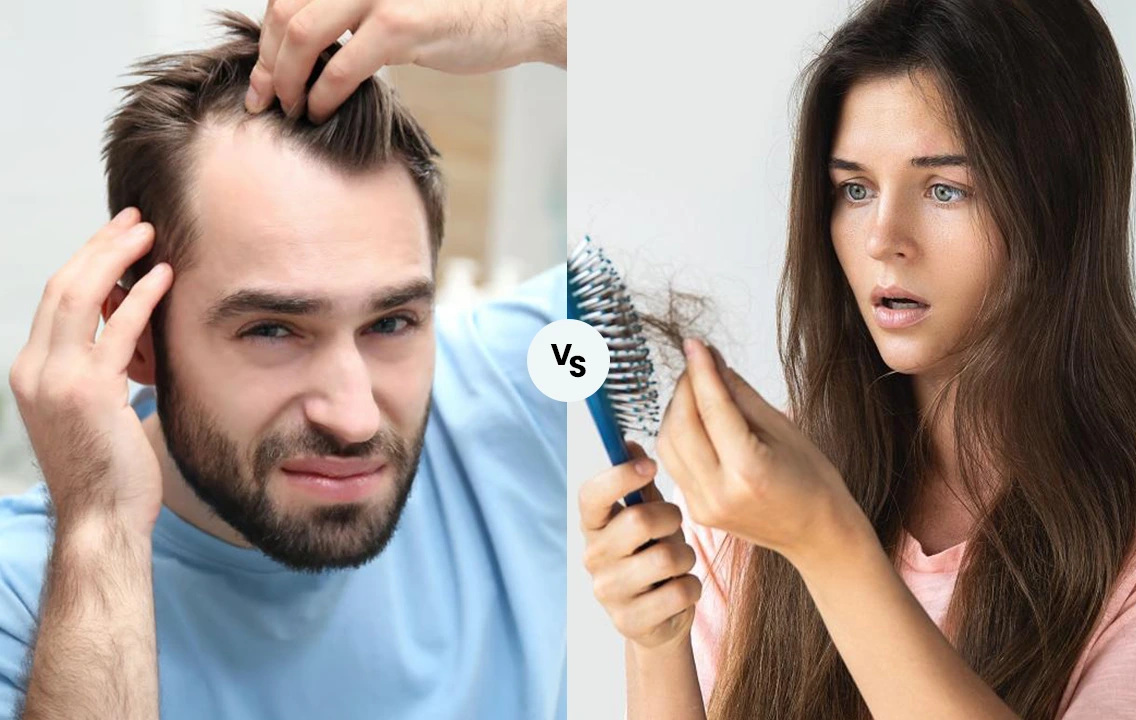
Recession at the temples, hairline, and thinning of hair at the crown is common in men while thinning of hair over the central scalp with widening of part is typical in women. There are various reasons for such patterns.
Genes play an essential part in hair loss; however, they are not the sole possible cause. It may be induced by such factors as stress, sickness, poor diet, hormonal imbalance, drugs, scalp ailments, and thyroid disorders. Although the type of hair loss can help one understand the cause of this condition, it is still necessary to diagnose it.
Men and women may both suffer from different kinds of hair loss, although the pattern of the hair loss can vary. In men, hair loss commonly presents as a receding hairline at the temples and thinning or balding at the crown. Women may suffer from diffuse thinning of hair at the center of the head, with a widening part line but intact front hair line.
However, exceptions to these patterns do occur. Some women may end up having receding hairlines, while some men can have hair thinning on a larger scale. The type of hair loss, how rapidly it occurs, and other signs can assist a doctor in determining the cause.
One of the most frequent forms of hair loss in males is androgenic alopecia, or male pattern hair loss. This is related to increased sensitivity to hormones known as androgens, specifically DHT.
The genetically predisposed follicles could be made sensitive by the androgens like DHT to have a shortened hair growth cycle, leading to a gradual miniaturization of follicles. This process may lead to the appearance of thinner and shorter hairs in relation to smaller follicles.
The sides and rear parts of the scalp generally have milder symptoms. However, the nature and rate of baldness differ from one person to another. Medical literature defines androgenetic alopecia as the most prevalent type of non-scarce hair loss.
Women may experience androgenetic alopecia as well, although there will be a difference in its pattern. Women will not have such a pronounced hairline recession; rather, they will have the widening of the parting area.
Characteristics of female pattern hair loss include progressive thinning of hair on the central scalp area, which is different from receding hairline in men. Thinning of the parting can be one of the symptoms since overall density is getting lower. Nevertheless, hair loss in females does not always mean androgenetic alopecia.
Female hair loss might be due to one or more reasons, such as:
As there can be multiple factors, a diagnosis cannot be made on the basis of visual observation alone. It could involve a physical examination, medical history, and even some blood tests.
Normal hair fall happens daily in the process of hair growth. But there may be increased hair fall due to stress either physical or mental, disease, operation, drastic weight loss, and even hormonal changes.
One of the most frequent reasons for increased shedding is telogen effluvium. While pattern hair loss involves gradual thinning of follicles, telogen effluvium usually leads to more visible hair loss from the entire scalp area. The hair regrowth might be observed after resolving the underlying factor but might take several months.
Not all hair loss is genetically based. An unexpected change in the volume or distribution of hair loss could be an indication of a cause that needs to be determined. An unexpected or an increase in hair loss may be due to telogen effluvium. It may be induced following a disease, operation, emotional stress, rapid weight loss, or a hormone change.
Hair loss can be associated with alopecia areata which is an autoimmune disease. Infections on the scalp, hairstyles and inflammation can also cause hair loss.
People who experience rapid hair loss, patchy hair loss or worsening of their condition are advised to consult a doctor as there are a few types of hair loss that cause permanent damage to the follicles.
No. Hair transplant is not the go-to choice for all hair loss patients. Initial or mild hair thinning might sometimes be treated using non-surgical treatment methods.
The following options can be considered:
It is important to determine the causes and the pattern of hair loss when selecting treatment. For instance, a treatment method that would suit androgenetic alopecia may not suit other types of hair loss such as alopecia areata, telogen effluvium or scarring hair loss.
Hair transplant surgery can be carried out if there has been advanced and stable hair loss, and the donor site has enough hair follicles. This involves the movement of hair follicles from the donor site (sides/back of the scalp) to thinning parts of the head.
In FUE, removal of follicular units individually precedes their transplanting into the recipient site. DHI is mostly related to a process of transplanting follicular units as opposed to an entirely new extraction procedure.
In case there is still on-going hair loss, it is suggested that the hair loss be first stabilized before undergoing surgery. This helps to maintain not only the implanted hair but also the natural hair of the patient. The best hair restoration physician must examine these before surgery.
Loss of hair should be evaluated medically when it occurs abruptly, patches appear on the head, or it occurs quickly with scalp symptoms. Pain, redness, scaling, itching, inflammation or smooth scalp could sometimes suggest that there is a problem with the scalp itself.
A medical assessment can also be considered if there are signs of hair loss with accompanying symptoms like severe tiredness and hormonal changes. This can help identify the underlying cause early enough to prevent further damage to the follicles.
Males frequently develop hairline recession, temple hair loss, and crown hair loss; while women usually experience thinning of hair in central scalp region and widening of their parting lines. But there may be some overlap in these conditions and one cannot rely only on the appearance to identify the causes.
Not necessarily. While genetics may play a role, hair loss may also be due to hormonal imbalances, stress, sickness, malnutrition, medication, thyroid problems, autoimmune disorder, or scalp disorder. It’s essential to know the cause first to select the proper remedy.
Consult a doctor in the case of unexpected and rapid hair loss or hair loss associated with some other symptoms like pain, redness, scaling, fatigue, or hormonal issues.
No. PRP treatment is not for every kind of hair loss. It is applicable only in selective cases of androgenetic alopecia. But it is difficult to ascertain that it would suit everybody. In such a case, it is advisable to seek professional advice.
Hair that is transplanted can provide hair growth on a permanent basis; however, the hair that was not transplanted could keep on getting thinner.
Different appearances can be noticed between the hair loss patterns of males and females because of differences in genetics, hormones, and hair follicles. Males generally have receding hairlines and thinning at the top of their heads. In women, hair loss is usually more diffused and involves widening at the central part.
On the other hand, the pattern itself cannot always help us find out what causes such hair loss. Sometimes patchy hair loss can be a symptom of some disease which should be diagnosed by a doctor. And only after diagnosing and setting up reasonable goals should one think about how to treat hair loss.